

14 April 2024
So, I realized that in the prior blog post that I stressed the importance of journaling your daily food and water intake, but didn’t give any resources or guidance for anyone new to an eating plan. I am so very sorry!
Keeping a log of your daily food intake really is tedious until you get used to doing it. It becomes a habit after a while, but until that time you have to be purposefully diligent in writing down everything you consume. Let’s go over the “why” first, and then we will talk about the “how.”
Why do we need to keep a food journal?
Whether you are eating for diabetes, cardio/hypertension, CKD, or just to shed some unwanted pounds you have daily limits that you must adhere to and keeping honest records of your daily eating shows you your progress over time and sets the benchmarks for your success. It lets you know where you are in your day’s allotments so you can prepare yourself for unexpected cake, spur-of-the-moment dinner with your sister, or plan for an evening of Mexican food and movies. Keeping a journal leaves a history of meals and food combinations that you enjoyed and that worked well for you, and bonus, Yo, lists their nutritional count so you don’t have to calculate them again! It’s also a record of those days where you weren’t at your best. Your food log is you talking to your future self - so while you are writing down the embarrassment of that Frap beverage you got yourself at the green coffee chain on every corner, forgive yourself by moving forward and jot down some words of inspiration and cheerleading. Remember that treats, cheats, and holidays happen. Your success depends upon your ability to make those moments few and far between, and to get right back on track. Journaling is you being accountable for your eating behavior and responsible for keeping yourself in line. And it works.
What’s the easiest and best way to keep a food journal?
There is no singular best way. It’s a very personal and individual thing, so you have to find what works best for you. There are some who can keep everything on their phone or who create a spreadsheet for themselves. Others need a preformatted journal, which you can purchase online or even at Wal-Mart - they are not very expensive and come in many styles (i.e. what information they record). I, myself, am a knight of pen and paper and use graph paper and a three ring binder. I tend to write big and sheet paper allows me to jot down recipes and reminders - and serves as a place to keep my food lists safe and handy. I also know that ticking off my daily servings as I eat them works extremely well for me. This is years of being an old school Weight Watcher.
Here’s one of my entry dates for you to check out:
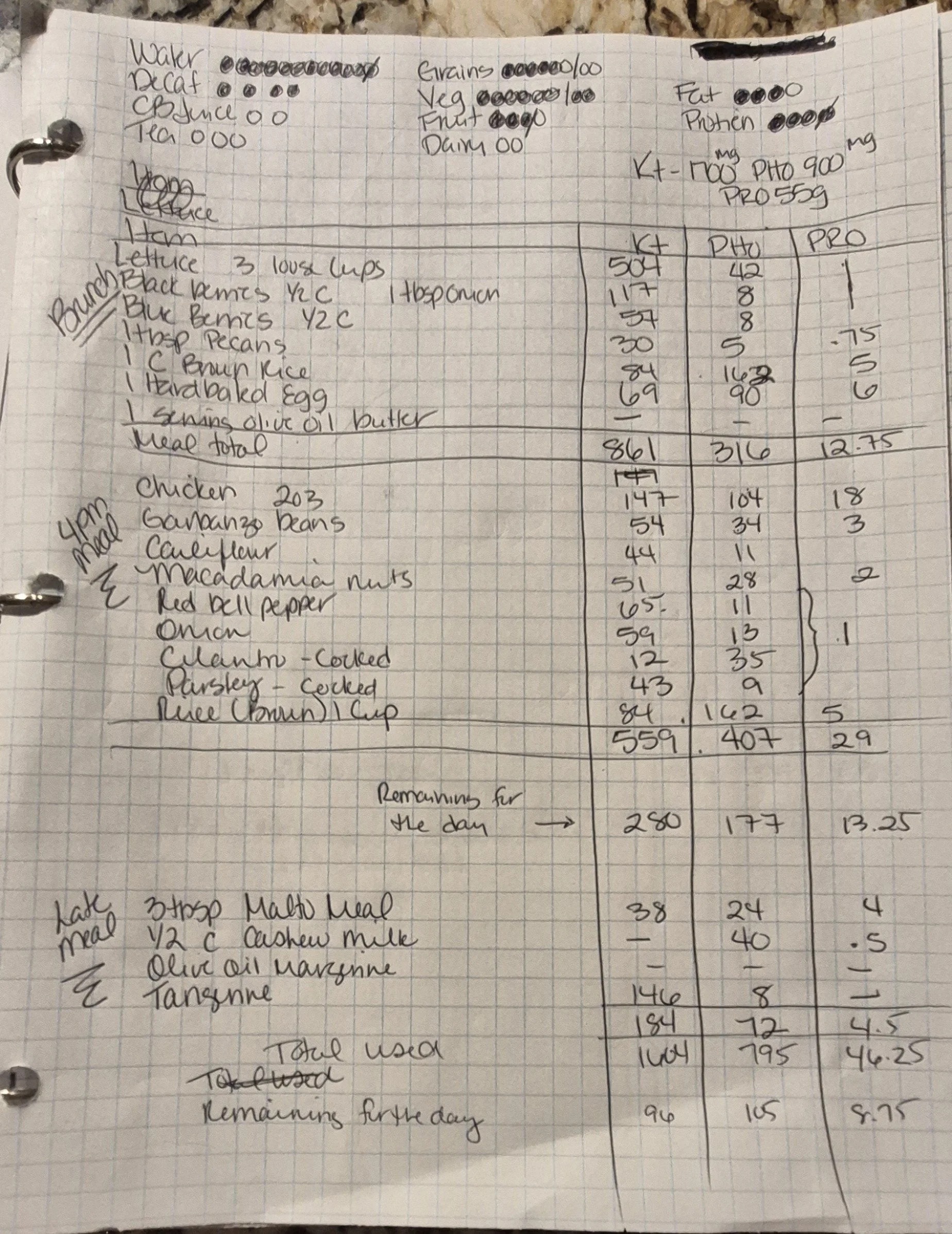
Graph paper RULES!
Notice that at the top of the page, the food groups are listed with circles indicating how many of each I can each day - that is Weight Watcher training - DASH also uses this format. I list my daily limits of potassium (K+) (note that my labs indicate that I can up to 2400mg of K+, but my allergy to it says “No, Sir!”), phosphorus (PHO) and Protien (PRO) at the top of the page, and then I have them broken down into columns. This is so I can list my noms and their values, add them up and check off their little circles as they are consumed. It leaves me a running total of nutritional count and a visual of what options I have left as I eat through my day. I keep myself in line by using my love of lists and crossing off my accomplishments. For me, this works. Mayhaps it will work for you, or serve you well as a guide as you learn what method suits you best!
As always, thank you so very much for the read and please let me know how I can help you with your daily food tracking! My goal is to help make things fun and easy as we walk down our food journey together!
Keep bein’ groovy!
-Sparks
